
Carbios showcases an enzymatic biorecycling technology for PET validated at the industrial demonstrator scale. The question now is less about scientific feasibility than about the company’s ability to finance and deploy its production units in the face of competitors advancing on different business models. Comparing trajectories allows us to measure where the real gaps lie.
Carbios vs. its direct competitors: industrial position table
Chemical and enzymatic recycling of PET attracts several players with distinct approaches. Their respective advancements are not only about technology but also about the stage of industrialization, revenue model, and geographical coverage.
| Criterion | Carbios | Eastman Chemical | Loop Industries |
|---|---|---|---|
| Technology | Enzymatic depolymerization | Methanolysis (chemical recycling) | Low-temperature chemical depolymerization |
| Industrial stage | Active demonstrator, Longlaville plant in financing | Operational plant in Kingsport (Tennessee) | Announced partnerships, no own production plant |
| Revenue model | Technology licenses + own production | Integrated production (diversified chemist) | Licensing and joint ventures |
| Geographical coverage | Europe + Wankai alliance in Asia | North America, European expansion | North America, European partnerships |
Eastman already has large-scale production capacity. This operational lead constitutes a tangible advantage in the North American market. Carbios, on the other hand, relies on an enzymatic process that operates at lower temperatures and produces PET of equivalent quality to virgin material, which remains a distinctive technical argument.
To delve deeper into Carbios’s evolution in the sector, one must also look beyond Europe: the alliance with Wankai, one of China’s largest PET producers, opens an Asian front with an announced investment of 115 million euros for a future biorecycling unit.
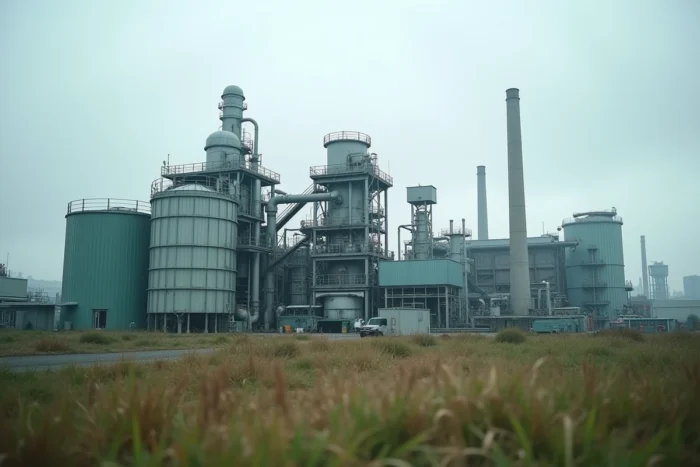
Financing of the Longlaville plant: the real bottleneck
The proof of concept is no longer in debate. The demonstrator in Clermont-Ferrand has surpassed 100 successfully produced batches, with over 95% conversion in 24 hours on complex post-consumer textile streams. Technological maturity is demonstrated.
The blockage lies elsewhere. The financial closure of the Longlaville project, Carbios’s first commercial plant in France, has been delayed. Several recent analyses point out that the main obstacle is the financing structure, not the technology. For a company that does not yet generate recurring industrial revenues, mobilizing the necessary capital for a unit of this scale remains a delicate exercise.
This situation creates an asymmetry with competitors like Eastman, who have cash flows from diversified chemical activities. For Carbios, each quarter of delay in financing extends the timeline before the first production revenues, which weighs on stock valuation and investor confidence.
Parameters that condition financial closure
- The ability to secure purchase contracts (offtake agreements) with partner brands, which serve as guarantees for lenders
- Access to European or French public funding related to the circular economy and reindustrialization
- The strength of the order book in licenses, which validates market demand with banks
Textile recycling: a new market, new obstacles
Carbios has expanded its licensing offer to the global textile market after validating its “fiber-to-fiber” biorecycling process on its demonstrator. Global consumption of PET polyester in textile applications is estimated at around 67 million tons per year, nearly double that of the PET packaging market.
This figure highlights the opportunity. It also masks the complexity of the terrain. Post-consumer textile waste is a mix of fibers, dyes, chemical finishes, and variable compositions. Collection and sorting rates remain low compared to packaging, and downstream infrastructure (specialized sorting centers, recovery channels) is still embryonic in most countries.
Unlike PET packaging, where collection circuits have existed for decades (bottles, trays), textiles require building an almost non-existent logistics chain. Carbios’s competitors in this segment are not the same as in packaging: players like Circ or Renewcell are working on different textile recycling processes, each with their own limitations.

Carbios stock price: what valuation gaps reveal
Carbios’s stock, listed on Euronext Growth Paris, reflects the tension between technological potential and industrial execution risk. Investors following this file know that the valuation incorporates an innovation premium but also a financing discount.
As long as the Longlaville plant is not financed and under construction, the market applies a reduction related to uncertainty. Each positive announcement (new partnership, regulatory advancement, licensing contract) raises the stock price, then the question of financing weighs again.
This pattern distinguishes Carbios from traditional industrial SMEs. The company is in a middle ground: too advanced to be treated as a pure biotech, not yet mature enough to be valued as an established industrial player. The profiles of investors interested in it must accept a return horizon aligned with the industrial timeline, not with quarterly results.
Factors to watch for the upcoming quarters
- The announcement of the financial closure of Longlaville, which could trigger a revaluation of the stock
- The concrete results of the alliance with Wankai in Asia and the construction timeline of the unit
- The European regulatory evolution on mandatory recycled content rates in packaging and textiles
- The progress of the licensing order book, particularly in the textile segment
The Carbios file reads like an industrial bet backed by validated technology. The gap with competitors no longer lies in science, but in the speed of deployment and the ability to mobilize capital in a market where investors remain cautious about long-term green infrastructure projects.