
A handcrafted piece of furniture is distinguished not by its price or label, but by the design logic that dictates its assembly, material choice, and finish. Understanding these technical parameters allows one to select decorative items that age well, can be repaired, and provide a visual signature that is impossible to replicate in mass production. Here are the key areas we prioritize to integrate artisanal craftsmanship into a contemporary interior.
Detachable Assemblies and Repairability of Handcrafted Furniture
The sectoral CSR reference framework 2025-2030 from Ameublement Français promotes a fundamental trend: detachable assemblies, screws instead of glue. For decorative furniture made from craftsmanship, this changes the game. A solid oak stool assembled with mortise and tenon joints can be disassembled, reglued if necessary, and passed down. A glued piece made in a workshop with polyurethane resin eventually becomes waste.
We recommend checking three points before investing in a handcrafted piece intended to structure your interior:
- The type of assembly (mortise and tenon, dowel, dovetail) and the presence of standardized, replaceable components
- The absence of irreversible glues on the main joints, which prevent any future intervention
- The possibility of disassembling the piece for moving or partial restoration without destroying the structure
These criteria go beyond mere aesthetics. They determine the actual lifespan of the object and its maintenance cost over ten or twenty years. A cabinetmaker capable of documenting their assembly choices offers a guarantee that industrial furniture does not provide.
This topic directly relates to the work of the color artisan on Cœur Artisan, where the transparent manufacturing approach guides the selection of decorative pieces.
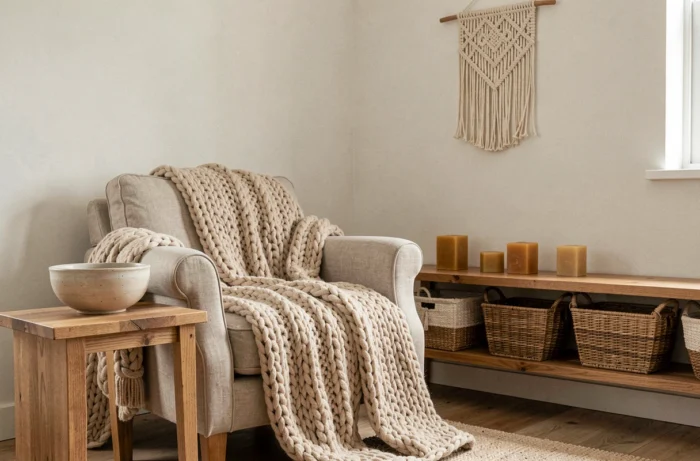
Reuse and Second-Life Furniture in Interior Decoration
Reuse is no longer a militant gesture reserved for flea markets. It has become a true field of artisanal creation. The Second Life Design Festival has shown how artisans design decorative pieces from existing furniture, reworking the material rather than adding new items.
Decorating with pieces made from existing furniture requires precise technical know-how. Stripping old wood without altering its patina, adapting a dresser structure to make a console, adjusting turned legs salvaged from a 1950s piece: each operation demands a reading of the material that mass production does not allow.
Repair days organized in several French cities confirm this interest. Sewing, leatherwork, and reuse furniture workshops assist individuals. The resulting decor carries a readable history, visible signs of use, and a color palette that only time can produce.
What Reuse Changes in the Style of an Interior
A tabletop made from reclaimed wood never presents two identical grains. The shades vary from one plank to another, creating an organic play of colors that no industrial color chart can replicate. It is precisely this irregularity that gives character to a living space.
Reuse also imposes dimensional constraints. One does not order a reused piece of furniture to the exact centimeter. This limitation encourages rethinking the layout, accepting a shift, an asymmetry. Controlled imperfection becomes a decorative choice, not a flaw.
Digital Prototyping and Artisanal Craft in the Workshop
3D printing does not replace the potter’s wheel or the wood chisel. It intervenes upstream: prototyping a shape, testing proportions, creating a ceramic mold before manual work. This combination of digital and manual techniques allows artisans to offer more refined decorative objects from the first series.
The final result remains entirely manual. A stoneware bowl whose mold has been optimized by 3D modeling retains the micro-variations of the glaze, the slightly uneven thickness of the wall, the trace of turning. Technology accelerates the research phase without smoothing the finish.
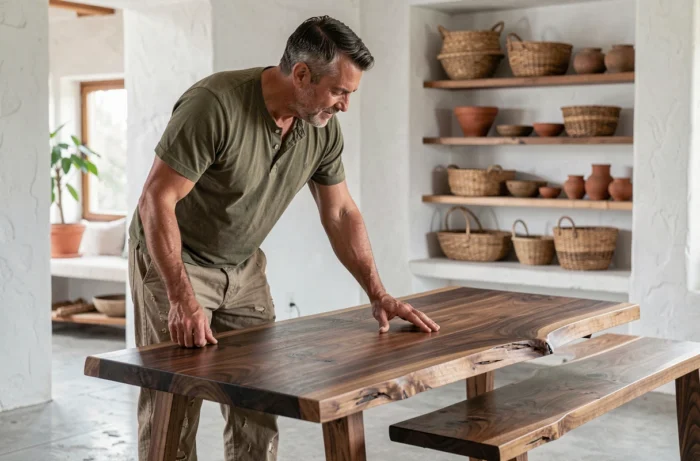
In cabinetry, artificial intelligence can help optimize cuts to limit material waste. An artisan working with walnut or ash, whose boards have variable knots and sapwood, gains material efficiency without sacrificing design quality.
Artisanal Decorative Textiles and Treatment Traceability
Regulations will gradually influence the choice of decorative textiles. Cushions, throws, and drapes from craftsmanship will need to document their treatments, finishes, and waterproofing solutions. For an informed buyer, this means asking specific questions to the artisan weaver:
- The nature of the stain-resistant or fire-retardant treatment applied, and its compatibility with everyday use
- The type of dye (vegetable, reactive, pigment-based) and its wash durability
- The exact composition of the yarn (linen, hemp, cotton, blend) and its geographical origin
A well-documented artisanal textile reassures as much as it decorates. Traceability becomes a selection criterion on par with pattern or color.
Choosing an Artisanal Decorative Object: Material, Workshop, and Finish
We observe a recurring mistake: selecting an artisanal object solely based on a photo, without information about the workshop or finish. A terracotta vase does not have the same durability depending on whether it was fired at low or high temperature. A piece of raw wood furniture reacts differently to humidity depending on the wood species and drying process.
The style of an interior is built through the accumulation of coherent material decisions. Combining solid oak furniture assembled in a workshop, ceramic objects fired in a wood oven, and cold-dyed linen textiles creates a sensory coherence. Each piece shares a logic of artisanal production that can be perceived by touch as well as by sight.
A well-chosen artisanal object structures a room better than a poorly contextualized designer piece. The material, format, and finish matter more than the signature. It is this framework that distinguishes a lived-in interior from a decorated one.