Pont-Saint-Esprit is not just a transit point between Gard and Ardèche. The town retains a dense medieval urban fabric, a 13th-century bridge among the longest in the Rhône valley, and a geographical position that opens onto the gorges of the Cèze, the first Ardéchois reliefs, and the Provençal plain. A practical question remains rarely addressed: how to explore this discovery without a personal vehicle, given that railway constraints complicate regional connections.
Line 30 UGGO and TER buses: the real network for traveling without a car
The free line 30 of the UGGO network is the only public transport route available to connect Pont-Saint-Esprit to the villages of the Cèze valley. It serves Saint-Paulet-de-Caisson, Saint-Julien-de-Peyrolas, and Aiguèze, with stops close to the town centers.
The route follows the valley to Aiguèze, classified among the most beautiful villages in France. Outside the summer season, the frequency requires planning each day around the bus schedules. There is no room for improvisation.
On the regional railway axis, ongoing works make the Pont-Saint-Esprit station unreliable. We recommend checking for TER bus substitutions before any trip from Avignon or Nîmes. Travel time is longer compared to the direct train, sometimes significantly so.
- From Avignon: substitute TER bus to Pont-Saint-Esprit, then transfer to line 30 towards Aiguèze or Saint-Julien-de-Peyrolas.
- From Nîmes: TER bus via Bagnols-sur-Cèze, then connect to the UGGO network.
- By camper van: the welcome area in Pont-Saint-Esprit allows parking and then using the bus network for day excursions.
This network does not cover either the gorges of the Ardèche or the Pont du Gard. Line 30 operates as a local circuit along the Cèze, not as an alternative to the car for the entire territory.
Medieval bridge, House of Knights, and sacred art: the built heritage of the old town
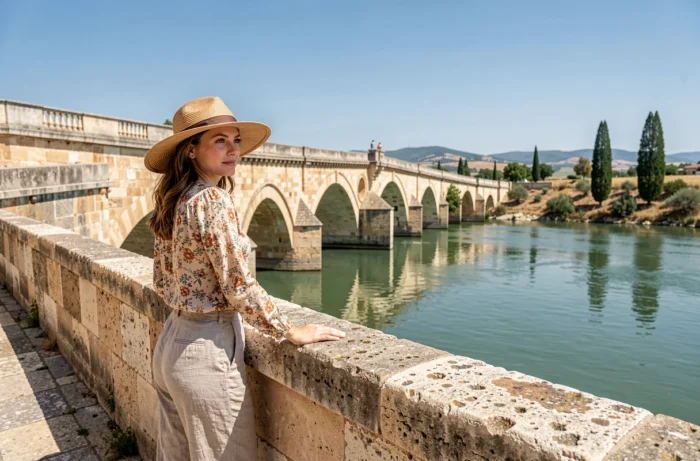
The medieval bridge structures the understanding of the town. Its construction spanned several decades in the 13th century, and the local economy organized around tolls and river trade. On foot, one can clearly distinguish the differences in masonry between the original arches and the successive restorations.
Travelers comparing the historic bridges of southern France, such as those documented on the Tuscany Unpacked website for other European regions, will find here a constructive logic comparable to works of the same era.
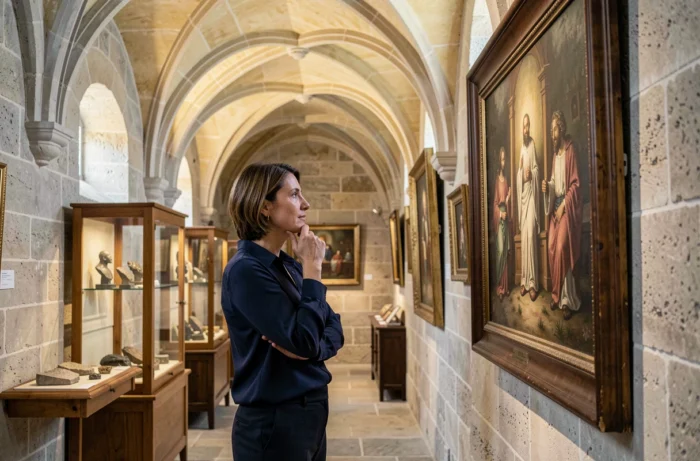
The House of Knights houses the Museum of Sacred Art of Gard. The medieval building, with its period architectural elements, justifies the visit as much as the collection, which covers liturgical production in Gard from the Middle Ages to the modern period.
Saint-Saturnin Church completes the tour of the old town. Its Romanesque apse contrasts with the Gothic alterations of the nave. The entire walking circuit between the bridge, the House of Knights, and the church can be completed in less than an hour, making it a well-timed morning before taking line 30 to the Cèze valley.
Guided tours: access to closed spaces during free visits
Commented tours cover the old town and provide access to spaces that are sometimes otherwise inaccessible, such as certain inner courtyards or high rooms of the House of Knights. The schedule tightens in the fall.
Aiguèze and the Cèze valley: swimming, garrigues, and perched villages
Aiguèze occupies a rocky spur overlooking the entrance to the gorges of the Cèze. The village retains a medieval castrum, narrow streets, and a steep view of the river. The descent to the Cèze beach is the most accessible swimming point without a car via the UGGO network, provided you keep an eye on the bus return schedules.
Between Aiguèze and Saint-Paulet-de-Caisson, the valley offers a landscape of garrigues and limestone cliffs less frequented than the gorges of the Ardèche. In Saint-Paulet-de-Caisson, the charterhouse of Valbonne is worth a detour. The site is accessible on foot from the bus stop, but the path crosses a rural area without sidewalks, a point to consider for families.
Gorges of the Ardèche: a complement dependent on a vehicle
The gorges of the Ardèche start a few kilometers northwest of Pont-Saint-Esprit. The scenic road between Vallon-Pont-d’Arc and Saint-Martin-d’Ardèche is not served by any regular line. Canoeing down from Vallon-Pont-d’Arc remains the flagship activity in the area, and canoe rental companies generally provide return shuttles, which partially compensates for the lack of a car for this specific excursion.
The most realistic solution for visitors without a vehicle: a taxi transfer or carpooling to Vallon-Pont-d’Arc, then the return shuttle from the rental company. The cost should be anticipated.
Cultural programming: Pont-Saint-Esprit beyond the high season
The tourist attendance in the town is not limited to July-August. The tourism office’s report after the summer indicates a change in visitor numbers, and the fall programming extends cultural activity beyond the summer peak.
The Photographic Encounters are a reference event for contemporary photography in the Rhône Gard. The format combines exhibitions in heritage sites and screenings, over several weeks in September.
The fall calendar adds heritage days, thematic visits, and structured hosting for camper van enthusiasts during dedicated gatherings.
Camper van: a base for exploring the Rhône Gard
Camper van parking in Pont-Saint-Esprit benefits from an identified area. This mode of stay allows combining personal vehicle and bus network for days without driving. The camper van offer structures itinerant tourism that escapes traditional hotel circuits and takes advantage of local markets for supplies.
Pont-Saint-Esprit operates on three levels: the old town for built heritage, line 30 for the villages of the Cèze, and a broader perimeter towards the gorges of the Ardèche that remains dependent on a vehicle. The free UGGO network and the fall cultural programming make the destination accessible well beyond the summer, provided that travel is planned in advance.