
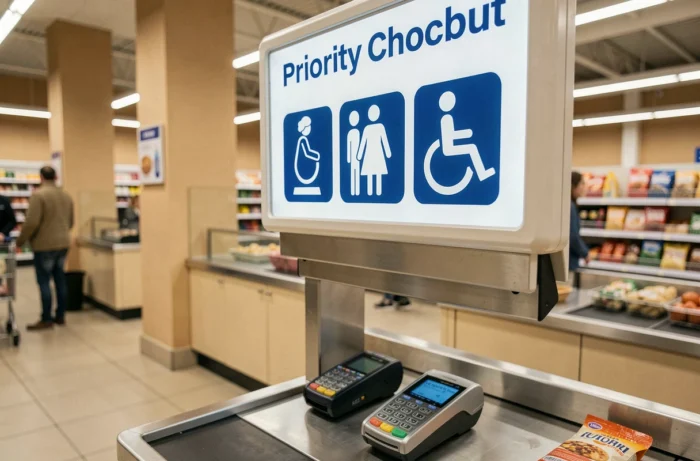
Priority checkouts in supermarkets raise recurring questions: who can use them, on what legal basis, and what obligations really weigh on the brands? Behind the pictogram displayed at the end of the checkout, the legal framework goes beyond mere courtesy and is part of a broader system of non-discrimination in access to goods and services.
Priority at checkout and discrimination: a recent legal shift
Competitors approach the priority checkout from the perspective of physical accessibility. The subject has taken on a new dimension in recent years. The work of the Defender of Rights now links difficulties in accessing priority checkouts to the field of combating discrimination in private services.
In practical terms, refusing or complicating priority access for a person with a disability, whether visible or not, can be classified as discrimination in access to a service. This framing goes beyond the notion of a “courtesy rule” often invoked in stores.
Complaints related to accessibility and violations of rights are indeed on the rise with oversight institutions. The Defender of Rights has integrated these issues into its plans against discrimination, reflecting a strengthened consideration by public authorities. To better understand the functioning of priority checkouts, one must therefore think beyond the mere signage in stores.

Legal obligation of stores: what the code really imposes
French law does not literally mention the term “priority checkout.” It imposes a priority access obligation in establishments open to the public for certain categories of people. Supermarkets, retail stores, and shopping centers fall within this scope.
Brands remain free in the practical organization of this priority. Three formats coexist:
- A physically dedicated checkout, marked by a pictogram, reserved for priority customers
- A “fast track” line allowing early access to any open checkout
- A priority passage at a standard checkout, at the discretion of the staff or upon request of the customer
Displaying the priority is mandatory and must be visible. However, the implementation format is not mandated by regulations, which explains the disparities from one brand to another.
Priority customers at checkout: comparative table of required documents
The most common confusion concerns eligible persons and the documents that attest to their rights. The table below summarizes the recognized situations and the associated documents.
| Priority group | Expected document | Particularity |
|---|---|---|
| Person with a disability (CMI disability) | Mobility inclusion card mentioning “disability” | Priority by law, no need to request it |
| Person with a disability (CMI priority) | Mobility inclusion card mentioning “priority” | Indicates a difficult standing position |
| Pregnant woman | No mandatory document (medical certificate possible) | Priority recognized without a specific card |
| Elderly person with reduced mobility | No mandatory document | Use of a cane, walker, or wheelchair |
| Accompanying person of a priority individual | No specific document required | Benefits from priority by extension |
The mobility inclusion card (CMI) issued by the MDPH remains the most recognized document in stores. The mention “priority” specifically concerns individuals whose standing position is difficult, without necessarily being related to a visible disability.
Invisible disabilities and waiting lines
Chronic illnesses such as fibromyalgia, multiple sclerosis, or chronic inflammatory bowel diseases (IBD) entitle individuals to priority as long as a CMI has been issued. The invisible disability represents the majority of conflict situations at checkout, as other customers do not perceive the legitimacy of the priority individual.
A medical certificate can complement the CMI in cases of pathological pregnancy or chronic pain not yet recognized by the MDPH. It does not have the same legal value but facilitates dialogue with staff.
Refusal of priority at checkout: applicable remedies and sanctions
A store that systematically refuses priority access exposes itself to legal action. The refusal can be reported to the Defender of Rights, who handles complaints related to discrimination in the private sector. The recent increase in complaints in this area confirms that users are becoming more aware of their rights.
Sanctions vary depending on the qualification retained:
- Discrimination in access to a service: possible criminal sanction, fine, and damages
- Failure to comply with the display obligation: fine under the consumer code
- Violation of dignity: aggravating qualification if the refusal is accompanied by humiliating remarks
Checkout staff do not have the right to require the presentation of the CMI as a prerequisite for passage. The card facilitates identification, but priority exists independently of its physical presentation, especially for pregnant women or elderly individuals.
Handivisible system in stores
Some brands, including Carrefour in several departments, have adopted the Handivisible system. This system allows individuals holding a CMI to signal their need for priority without having to address other customers or staff. More than 300 stores are already using this system, which aims to reduce the psychological burden associated with requesting priority.
The MDPH in certain departments are beginning to directly inform CMI holders about the existence of this type of solution, which could accelerate its deployment.
The legal framework for priority checkouts goes far beyond the signage at the end of the aisle. The current trend links these issues to non-discrimination law, with increasingly structured remedies. For those concerned, keeping their CMI handy remains the most effective reflex, even if the law does not formally require it.