
Changing your registration certificate is not just about filling out an online form. Behind the generic term “change of registration certificate” are several types of procedures, each with its own pricing structure. The price of the registration certificate depends on a combination of taxes, the amounts of which vary according to the region, the type of vehicle, and its age.
Regional tax and fiscal horsepower: the factor widening the gap in 2026
The regional tax constitutes the largest portion of the cost of a registration certificate. It is calculated by multiplying the fiscal horsepower of the vehicle by the rate of the fiscal horsepower set by each regional council. However, in 2026, disparities between regions have further increased.
Île-de-France applies a rate of 68.95 euros per fiscal horsepower since March 1, 2026. In contrast, some regions remain close to 30 euros per fiscal horsepower. For the same vehicle with 7 fiscal horsepower, the regional tax alone can therefore vary from simple to double depending on the holder’s place of residence.
This year, several regions have raised their rates during the year, complicating estimates for buyers. Checking the applicable rate at the exact time of the request, and not the one displayed at the beginning of the year, avoids unpleasant surprises. To better understand the price of changing the registration certificate, it is essential to incorporate these frequent regional revisions into the calculation.
Electric vehicles and registration certificate: the end of a tax advantage

Until recently, registering a 100% electric vehicle was significantly cheaper due to the exemption from regional tax granted by almost all regions. This is no longer the case.
Since May 1, 2025, most regions apply the full regional rate to electric vehicles. In 2026, Hauts-de-France is among the few to still maintain an advantage, in the form of partial or total exemption depending on the case. For all others, the registration cost of a new or used electric car is now comparable to that of an equivalent thermal vehicle.
This change significantly increases the total budget for acquiring an electric vehicle. A buyer who relied on a nearly free registration certificate must now factor in several hundred euros more depending on the fiscal horsepower of the chosen model.
Composition of the registration certificate price: taxes line by line
The total amount of the registration certificate is not limited to the regional tax. It aggregates several distinct components, and confusing them skews the estimate.
- Regional tax (Y.1): fiscal horsepower multiplied by the fiscal horsepower rate of the region. Divided by two for vehicles over 10 years old.
- Tax on polluting vehicles (ecological penalty): applicable to new or imported vehicles never registered in France, calculated according to the current CO2 scale. The triggering threshold was lowered in 2026.
- Management fee and processing fee: fixed amounts, identical across the territory, which are added to the total to cover administrative processing costs and the secure mailing of the certificate.
For a change of ownership on a used vehicle, the ecological penalty does not apply. The invoice then relies on the regional tax (possibly reduced by half if the vehicle is over 10 years old), the management fee, and the processing fee.
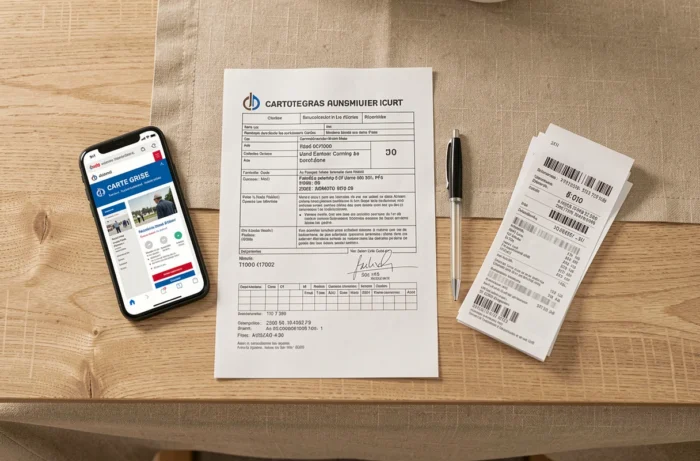
Procedure for changing the registration certificate: what concretely blocks on the ground
Since the complete dematerialization of registration requests, all procedures go through the France Titres website (formerly ANTS). The process is supposed to be simple: create an account, provide the vehicle information, upload documents, and pay online.
In practice, user feedback regularly reports difficulties. Issues with site accessibility, variable processing times, and blocks during the upload of supporting documents frequently arise. The provisional registration certificate (CPI) allows circulation for one month while waiting for the final title, but some users report delays that exceed this timeframe.
The necessary documents vary depending on the type of procedure. For a change of owner after a sale, the file includes:
- The Cerfa form for registration request
- The old registration certificate crossed out, dated, and signed by the seller
- The certificate of transfer (dedicated Cerfa)
- A proof of residence less than six months old
- A valid technical inspection for vehicles over four years old
The absence of a single document leads to the rejection of the file, which extends the procedure by several weeks. The seller must also declare the transfer online within 15 days; otherwise, the blockage may also come from their side.
Change of address on the registration certificate: a free but little-known obligation
Any change of address must be reported within one month. This procedure is free and does not generate any tax. It results in the sending of a label to be affixed to the registration certificate for the first two changes, and then a new document for the third.
Failing to update your address exposes you to a flat fine. It is also a source of confusion: some users think they have to pay for a new registration certificate when updating the address incurs no cost.
The actual cost of changing the registration certificate therefore depends as much on the type of procedure as on the region of residence and the age of the vehicle. With the gradual removal of exemptions for electric vehicles and the regional rate increases observed in 2026, the registration budget is becoming a factor to be seriously anticipated, including for powertrains that were previously largely exempted.