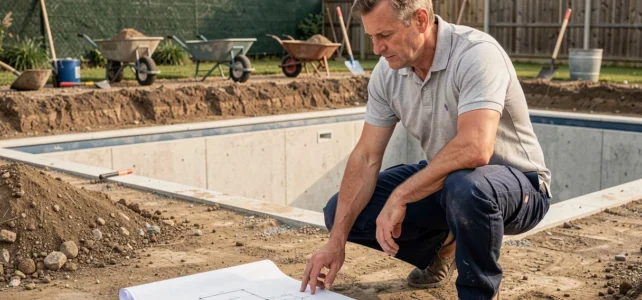
Before contacting a pool installer, most individuals underestimate the actual cost of an in-ground pool. The price of the pool itself is only part of the bill. Excavation, taxes, safety equipment: these peripheral items can significantly increase the budget by several thousand euros without being anticipated.
Pressure on in-ground pool quotes in 2026
Have you noticed that the quotes received this year seem higher than those of your neighbors two years ago? It’s not just an impression. According to the Federation of Pool and Spa Professionals, demand for private in-ground pools has risen again, driven by repeated heat waves that saturate public facilities.
This pressure on demand directly affects prices. Labor is mobilized for longer periods, materials are ordered in larger quantities, and project timelines are extended: all these factors inflate quotes, even for pools of modest size.
In practice, it’s better to plan for a safety margin of at least 10 to 15% above the initial quote. A project launched in the height of summer will almost always cost more than one scheduled in autumn or winter, when pool installers’ activity slows down. To accurately estimate the budget for an in-ground pool, this economic reality must be integrated from the initial costing phase.
Hidden cost items of pool construction
The price quoted by a builder generally covers the structure of the pool, basic filtration, and installation. However, several additional expenses remain the responsibility of the owner.
Excavation and site access
A sloped, rocky, or hard-to-access site for an excavator significantly increases excavation costs. On clay soil, the risk of ground movement sometimes requires peripheral drainage, which is rarely included in the standard quote.
Why is this item so variable? Because two neighboring plots can have completely different subsoils. A preliminary soil study, costing a few hundred euros, avoids unpleasant surprises during construction.
Mandatory safety equipment
The law requires at least one standardized safety device among four options:
- A protective barrier (NF P90-306 standard), the most common solution for families with young children
- An immersion or crossing detection alarm (NF P90-307 standards), less expensive but not a physical barrier
- A safety cover (NF P90-308 standard), which protects the pool while limiting evaporation and cooling of the water
- A pool shelter (NF P90-309 standard), the most expensive option but which extends the swimming season
The absence of a compliant device exposes you to a fine of up to 45,000 euros. This item must be included in the initial budget, not treated as an optional accessory.
Connections and site restoration
The electrical supply for the technical room, water connections, and drainage water disposal generate costs that are often forgotten. Restoring the site surroundings (damaged lawn, moved fences, pathways damaged by machinery) adds to the final bill.
Fiscal impact of an in-ground pool on property tax
An in-ground pool is considered an ancillary construction. It increases the cadastral rental value of your property, resulting in a lasting increase in property tax.
Declaration is mandatory within 90 days following the completion of the work, via form 6704 IL. An undeclared pool exposes you to a tax reassessment with penalties. Since 2022, the tax administration has been using aerial detection tools to identify undeclared pools, and this monitoring is strengthening each year.
Beyond property tax, the development tax applies at the time of construction. Its amount depends on the surface area of the pool and the rate voted by the municipality. This one-time cost, sometimes several thousand euros, must be included in the overall budget as soon as the preliminary work declaration or building permit is submitted.
Choosing the type of structure and balancing quality and price
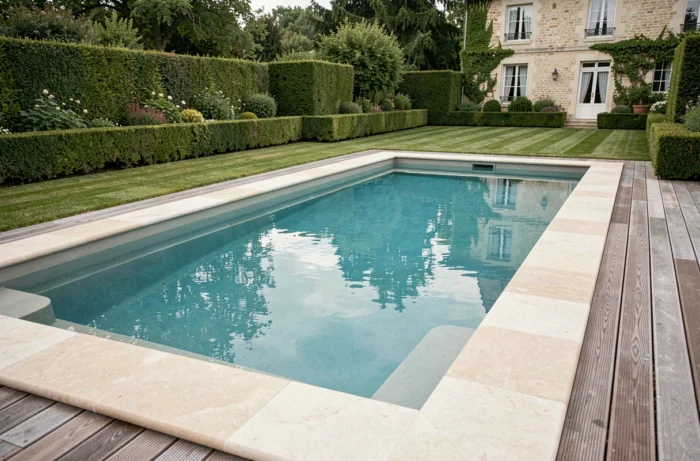
The material of the pool determines both the construction price, the duration of the project, and the long-term maintenance costs. Three main categories stand out.
The polyester shell pool offers the fastest construction. The shell arrives prefabricated and is installed in a few days. The budget remains contained, but the shapes and sizes available are limited to the manufacturer’s catalog.
The concrete pool (cinder blocks, poured concrete, or shotcrete) allows for total customization. Shotcrete, also known as gunite, produces a very durable monolithic structure. The downside: a longer project and a significantly higher cost, justified by the heavy logistics and technicality of the implementation.
The kit pool is a compromise for experienced DIYers. The structure (steel, wood, or composite panels) is delivered in components to be assembled. The savings on labor can reach one-third of the total budget, provided that critical steps are mastered: excavation, leveling, hydraulic and electrical connections.
Recurring costs after filling
The budget for an in-ground pool does not stop at the completion of the project. Annual maintenance involves several items:
- Water treatment products (chlorine, bromine, salt for electrolysis) and regular analyses
- Electricity consumption of the filtration pump, which runs several hours a day in season
- Periodic replacement of the filtering medium (sand, glass, zeolite) and wear parts
- Winterizing and spring start-up, which can be done by oneself or entrusted to a professional
A often overlooked point: water consumption. The initial filling represents several cubic meters, and regular top-ups to compensate for evaporation increase the water bill, especially in regions subject to summer restrictions.
Anticipating these recurring expenses helps avoid the tunnel effect of “all in construction, nothing for after.” A well-budgeted pool includes at least two to three seasons of operation in the initial calculation, not just the cost of the project.