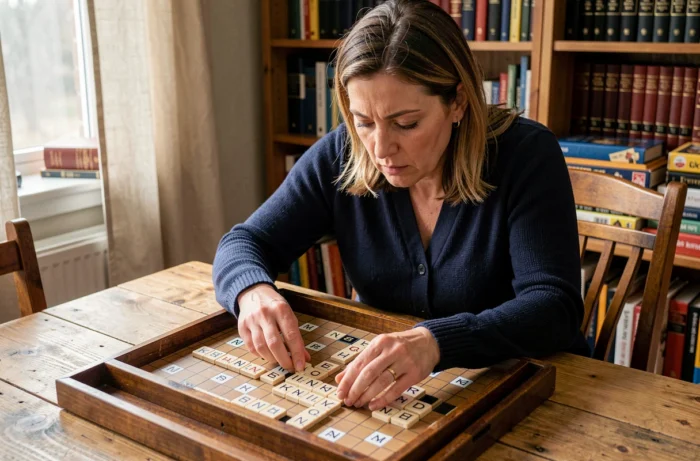
You place a word on the board, your opponent furrows their brow and pulls out the dictionary. This scene is familiar to every Scrabble player. Checking the validity of a word before placing it is the skill that separates the lucky player from the reliable one. However, one must know which reference to use and understand that a word accepted by the dictionary does not always validate a move.
ODS9, TWL or house rules: which dictionary applies to your Scrabble game
Before even checking if a word exists, one must ask a more basic question: which list is authoritative in the current game? In Francophone competition, the reference is ODS9, which came into effect in January 2024 according to the Fédération Française de Scrabble.
In friendly games, there is nothing to prevent setting another edition or even a common dictionary as a reference. The problem arises when each player assumes that “the dictionary” is the same for everyone. An online checker based on ODS9 will display “valid” for a word that your opponent disputes because they are playing with ODS8 or a Larousse.
Set the lexical reference before drawing the first letters. This is the only way to avoid fruitless disputes during the game. You can also find valid words for Scrabble on Cariboost, along with a reminder of the basics for playing without disputes.

A valid word does not mean a valid move: the distinction players often forget
This is the most common trap among intermediate players. You check that the word exists in the ODS, you place it, and then discover that it creates an invalid crossing with an adjacent column. The checker says “yes,” the board says “no.”
A legal move requires that every word formed by crossing must also be valid. If you place QUIET horizontally and the Q creates QA vertically with an A already in place, QA must exist in the reference dictionary. If it does not, the entire move is canceled, even if QUIET is perfectly valid.
Verification thus occurs in two stages:
- The main word you place must be in the chosen reference (ODS9 in competition).
- Each secondary word formed by crossing your letters with those already on the board must also be valid.
- The placement itself must respect the continuity of the board: at least one letter of the new word touches an existing letter (except for the very first move, placed on the central square).
In clubs, referees systematically check crossings. In friendly games, they are often overlooked, leading to undue points and conflicts at the end of the game.
High-value letters and bonus squares: where verification changes the strategy
Checking a word is not just about ensuring it exists. It is also about deciding if that word is the best choice among all possible words with your draw. Experienced players work as much on reading the board as on pure vocabulary.
Exploiting short words with rare letters
Two or three-letter words with W, X, Y, Z, or K are formidable weapons. They allow you to place a high-value letter on a bonus square (double letter score, triple letter score) while forming a profitable crossing. The word WU, for example, is valid in ODS9. Placing the W on a triple letter score square earns much more than keeping it for a hypothetical long word.
Memorizing about twenty short words with expensive letters transforms your average score. Here are the categories to prioritize:
- Two-letter words with W, X, Y, and K (WU, XI, YE, KA, among others, depending on the current edition).
- Three-letter words with J or Z, often playable in parallel to double crossing points.
- One-letter extensions: adding an S, E, or R to an already placed word to create a new word simultaneously.
Before validating any of these words, the reflex remains the same: check in ODS9 (or the established reference). Responses vary on this point, as some short words accepted in one edition disappear in the next.

The joker changes the game, not the verification rules
The joker (blank tile) can represent any letter, but the word formed must always be valid. What changes is the value: the joker is worth zero points, so placing a Z via a joker earns nothing for that letter. It is better to use the joker to unlock a draw or reach a triple word score square, not to replace a common letter.
Online checker or memory: how to progress concretely in Scrabble
The checker from the Fédération Française de Scrabble, based on ODS9, remains the reference tool for resolving disputes. In friendly games, it is used after the disputed move. In training, it is used beforehand, to learn.
The most effective method for improvement combines two practices. First, play a game and note every word you doubt, without checking during the game. Then, after the game, run all these words through the checker. This delay between doubt and answer anchors memory much more than immediate verification.
Mobile applications for offline checkers are convenient on the go, but be careful about the dictionary edition included. Some have not been updated since ODS8 and will display outdated results.
Scrabble rewards preparation as much as inspiration. Setting the dictionary, checking crossings, knowing profitable short words: these three habits are enough to turn the majority of games in your favor.