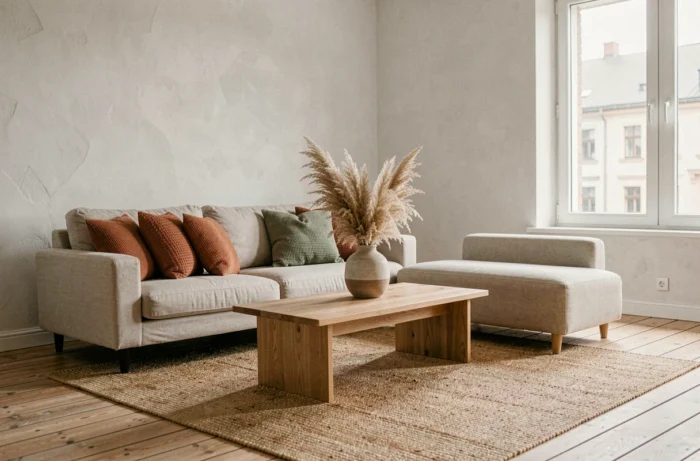
A sofa whose fabric pills after six months, a wall repainted in a shade that changes under LED lighting, a particle board piece of furniture that emits a persistent odor for weeks: we have all experienced at least one of these decor fails. Transforming your interior is not just about following a Pinterest board. The choices of materials, lighting, and space circulation determine the real comfort in daily life, far beyond the visual effect.
Indoor air quality and material choices for decoration
When changing a piece of furniture, flooring, or curtains, we also modify what we breathe. In France, construction and decoration products have carried a label of emissions ranging from A+ to C since September 1, 2013. A particle board panel rated C can emit volatile organic compounds for several months after installation.
We tend to focus on the color or price of the furniture without flipping the label. Sofa foams, particle boards, and certain treated textiles are the main sources of pollutants in a living room or bedroom. Opting for solid wood, thick linen, or untreated cotton reduces this exposure.
The French law n° 2025-188 of February 27, 2025, plans to ban PFAS in upholstery textiles starting January 1, 2030. These substances, used to make fabrics stain-resistant or water-repellent, concern curtains, sofa covers, cushions, and textile coverings. Anticipating this regulation is also making a sustainable decor choice: natural linen or thick wool ages better than treated polyester. You gain in texture, durability, and air quality.
To explore these material questions and find suitable options for each room, Côté Déco’s decor advice addresses these topics in a concrete manner.

Living room and living space lighting: layering light sources
A single ceiling light in the center of the room is the default setup in most homes. And it’s also the least flattering. Direct lighting produces harsh shadows, flattens volumes, and strains the eyes in the evening.
Layering three levels of light radically transforms the ambiance of a room. The principle is simple:
- A soft general lighting (dimmable ceiling light or diffusing pendant) that ensures basic visibility without glare.
- Accent lighting (wall sconces, adjustable spotlights) to highlight a wall, a bookshelf, or an object.
- Ambient lights close to the floor or placed on furniture (table lamps, warm white LED strings) that create depth in the evening.
The choice of color temperature is as important as the position of the fixtures. In a living room or bedroom, stay below 3,000 kelvins for warm light. In a kitchen or workspace, slightly increase it to maintain alertness. Feedback varies on this point depending on individual sensitivity, but going below 2,700 K often results in a too-yellow appearance on light walls.
Circulation and layout: rethink the plan before buying
We often buy the furniture first, then look for where to place it. The reverse approach works better. Before any spending, we draw the circulation axes of the room: entry door to the kitchen, sofa to the TV, access to the balcony. Each regular route should remain clear with a minimum width of 60 centimeters.
In an open living-dining room, the classic trap is to push everything against the walls. A sofa placed 30 centimeters back creates a useful backdrop (console, low storage) and breaks the corridor effect. A dining table slightly offset from the geometric center of the room frees up a more comfortable passage on one side.
Small spaces: mistakes that visually shrink
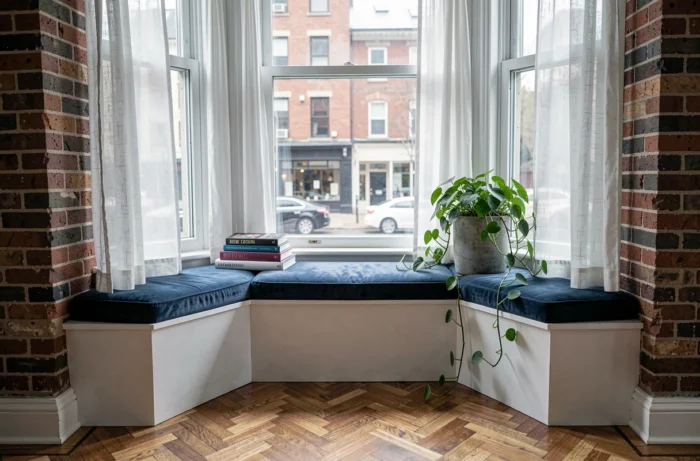
In a studio or a two-room apartment, accumulating small furniture produces the opposite effect of what is desired. Two well-sized pieces of furniture structure better than a dozen small elements scattered around. A tall, narrow shelf takes advantage of verticality without encroaching on the floor.
The mirror remains an effective lever for visually enlarging a space, provided it is placed facing a source of natural light. Positioned opposite a dark wall or a hallway, it merely duplicates the narrowness.
Second-hand and reuse: between decor trend and reality of volumes
Vintage is everywhere in magazines and on social media. We talk about hunting for treasures, repurposing, giving a second life to old furniture. The reality of the numbers tempers the enthusiasm: in 2025, Ecomaison processed 1.97 million tons of household items and materials, but only 5% were directed towards reuse.
This gap means that finding a second-hand piece in good condition takes time and selectivity. You don’t stumble upon a solid walnut dresser with every visit to a recycling center. For reuse to work in decor, we target pieces that age well:
- Solid wood (oak, walnut, cherry), which can be sanded and refinished easily.
- Ceramics and stoneware (vases, lighting), durable and timeless.
- Old frames and mirrors, often better made than their new counterparts.
- Wood or metal seating that can simply have the fabric changed.
Particle boards from the 1990s-2000s, on the other hand, age poorly. They swell with humidity, cannot be repaired, and may continue to emit pollutants. It’s better to avoid them, even at a symbolic price.
Colors and wall renovation: test before committing
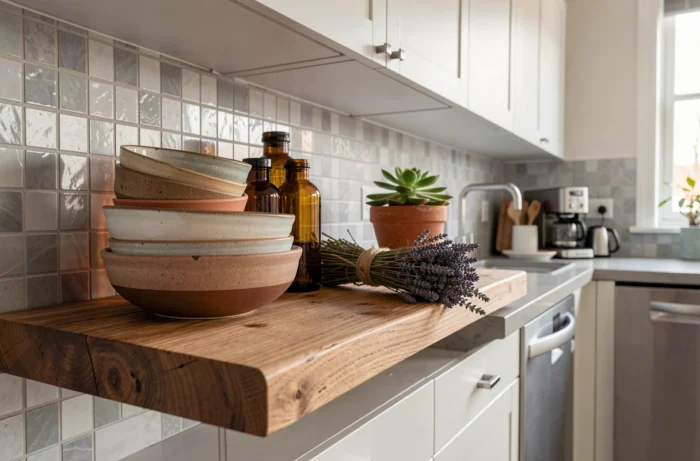
You see a shade on a screen, imagine it on a 12 m² wall, and the result rarely surprises in a good way. Natural light in the room significantly alters the perception of a color: a sage green appears gray in a north-facing room and much brighter in full south.
The most reliable method is to paint a sample of at least 50 x 50 cm directly on the concerned wall, then observe it at different times of the day. Two days of observation are enough to avoid a purchase of 15 liters of paint that you will regret.
In terms of trends, terracotta shades, deep greens, and warm off-whites dominate current palettes. But the most successful color remains the one that matches the existing furniture and the actual lighting of the room, not the one from the most shared color chart on social media.
An effective interior relies on coherent choices between materials, light, and layout. Each of these levers can be worked on independently, but it is their articulation that produces the result. Starting with what we breathe and what we see first (the walls, the light, the volumes) provides a solid foundation before adding decorative elements.