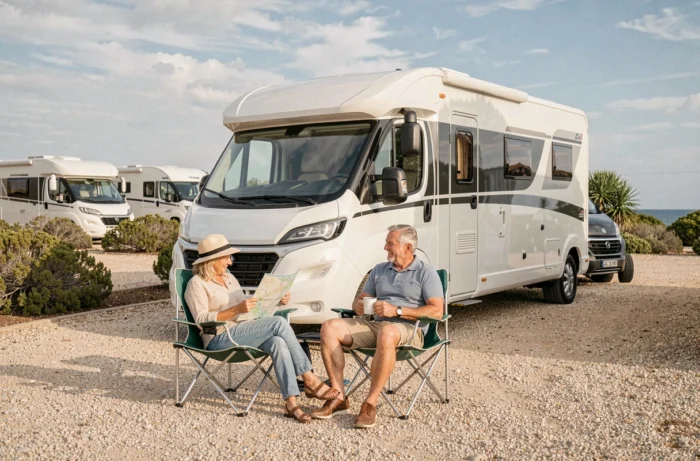
A motorhome area is defined by three functions: parking, emptying, and refilling with water. When a municipality on the Mediterranean coast opens a new facility of this type, feedback from the first users rarely focuses on the landscape. What gathers opinions are the technical services, pricing, and coexistence with local regulatory constraints.
Motorhome parking in coastal areas: what the regulations change for users
Reviews published on recent coastal areas often return to a persistent misunderstanding. Many motorhome users believe that a limit of 24 or 48 hours applies everywhere in France. No national rule sets a duration of 24 or 48 hours for parking a motorhome on public roads.
The general rule is that of Article R417-12 of the Highway Code: a vehicle, including a motorhome, can remain parked at the same spot for up to seven consecutive days before the parking is classified as abusive. Shorter durations displayed on some signs result from municipal orders, taken on a town-by-town basis.
On the Mediterranean coast, several municipalities have tightened their approach in recent years. Targeted bans on camping and caravanning along the shores coexist with official paid areas. This regulatory pressure partly explains why motorhome users discovering the new motorhome area in Sainte-Marie-de-la-Mer express relief: having a legal spot with services avoids the risk of fines in an unauthorized parking area.
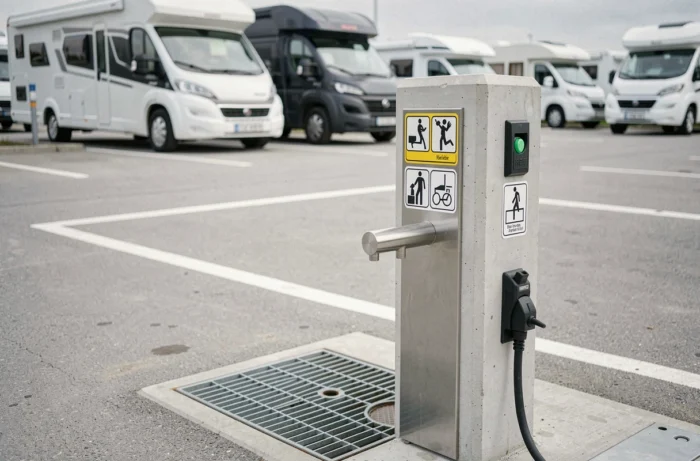
Electricity billing by kWh and drinking water: services that divide opinions
The most commented point on recent areas concerns the billing of electricity by actual kWh. This system, adopted by some areas in southern France, replaces the classic hourly flat rate. Users who consume little (charging auxiliary batteries, lighting) find a net advantage. Those who connect air conditioning or electric heating pay more than with a fixed rate.
Feedback also varies on the availability of drinking water. In some areas, filling is only accessible during the day, which surprises travelers arriving in the evening. This time constraint, rarely mentioned in online descriptions, generates recurring negative reviews.
Technical criteria that appear in reviews
- The nature of the ground (gravel, grass, asphalt) and its ability to support heavy vehicles without sinking, especially after rain
- The presence or absence of showers and complete sanitary facilities, which distinguishes a basic area from a space close to camping
- The mobile phone network on site, often weak in isolated coastal areas, complicating cashless payments
- The actual distance to shops and the beach, sometimes overestimated in official descriptions
A flat spot, functional emptying access, and a reliable electrical point form the minimal foundation for receiving positive reviews. The absence of any one of these three elements is enough to lower the overall rating.
Motorhome area and free parking: why motorhome users compare
User experiences are not read in isolation. Users systematically compare the paid area with the free alternatives available in the same vicinity. In Saintes-Maries-de-la-Mer, the Plage Ouest parking lot accumulates several hundred online reviews, with an average rating of around 3.8 on Google.
This free parking offers a flat and gravelled spot in direct proximity to the sand. In return, the services are limited: a urinal, gray water disposal bins, but no showers or permanent electrical point. The choice between paid area and free parking depends on the expected level of comfort, not just the price.
Autonomous motorhome users (solar panel, sufficient water tank, onboard toilets) often prefer free parking. Those traveling as a couple or family, with needs for electricity and sanitary facilities, value the equipped area more. Reviews reflect this divide: the same place can receive five stars from a minimalist traveler and two stars from a user who expected camping services.
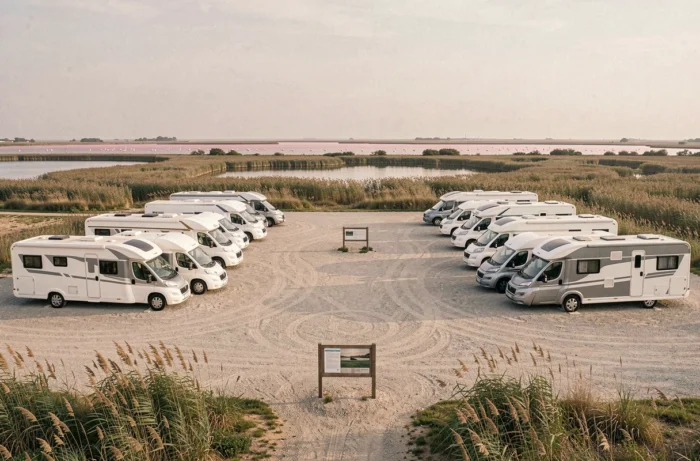
Pricing and price transparency: the most significant criterion in reviews
Price transparency concentrates a notable share of positive or negative comments. Areas that display a total price per night (parking, water, electricity included) receive more consistent reviews. Those that pile on extra charges (additional electrical point, shower token, unmentioned tourist tax) generate frustration.
In the Mediterranean coastal areas, prices vary significantly depending on the season. A significant price gap between high and low season is the norm, but users often complain about the lack of prior information. When the price displayed on a listing app does not match the actual price on site, the negative review is almost automatic.
What concretely improves the rating of an area
- A clearly displayed all-inclusive price at the entrance, with no hidden fees
- A staff presence on site, even briefly, to guide newcomers and sell tickets
- A regular update of information on platforms (Park4Night, Google Maps) to avoid discrepancies between description and reality
The areas that receive the best ratings over time are not the cheapest or the most equipped. They are those where the service matches exactly what was announced. A modest spot but honestly described receives better feedback than a premium area whose reality disappoints compared to the promises.