
Solidarity tourism refers to a form of travel where a portion of the generated income directly benefits local communities, and where the stay is organized around real cultural exchanges with the locals. This operational definition distinguishes it from responsible tourism (focused on environmental impact) and fair tourism (which emphasizes fair compensation for local service providers). The three concepts overlap, but solidarity tourism places economic redistribution and human connection at the heart of the travel project.
European Directive 2024/825 and the end of self-proclaimed labels in tourism
A major regulatory change will modify how solidarity travel operators communicate. The Directive (EU) 2024/825, applicable from September 27, 2026, prohibits generic terms like “eco-responsible,” “green tourism,” or “sustainable accommodation” if the operator cannot demonstrate environmental performance verified by an independent third party.
Self-proclaimed labels and claims such as “neutral impact thanks to carbon offsetting” will be considered misleading commercial practices in the absence of robust certification. For solidarity tourism structures, this directive represents both a constraint and an opportunity: those already operating with documented local partnerships and traceable redistribution will have a concrete advantage over operators who relied on marketing gloss.
Resources like tourisme-solidaire.org help identify sectors engaged in this transparency approach, ahead of the directive’s implementation.

Solidarity tourism and local economic redistribution: how it works
The central mechanism of solidarity tourism relies on a short financial circuit. Part of the price of the stay is directed towards collective projects in the host community: school construction, access to water, support for agricultural cooperatives. This allocation distinguishes the solidarity model from a simple stay with locals booked through a rental platform.
In practice, solidarity travel operators work with local partners who co-construct the program. Accommodation often takes place in local homes or in community-managed structures. Meals are prepared with local products. The guides are residents of the visited area.
Redistribution is not symbolic but structural: it conditions the very organization of the stay. This is what makes it verifiable, unlike a simple donation attached to a conventional booking.
What the solidarity traveler concretely finances
- Collective infrastructures (schools, clinics, wells) decided by the communities themselves, not by the tourism operator
- Direct payment to host families, artisans, and local guides, without international intermediaries
- Development funds managed by local associations, with oversight from residents regarding the allocation of funds
Le Meur Law and regulation of tourist accommodations: a favorable French context for solidarity
Law No. 2024-1039, known as the Le Meur Law, adopted on November 19, 2024, strengthens the regulation of tourist accommodations in France. Mandatory registration, stricter regulation of short-term rentals: these measures aim to limit the pressure of mass tourism on housing in tight areas.
For solidarity tourism, this regulatory tightening creates a positive indirect effect. Solidarity stays do not rely on apartments removed from the conventional rental market. They use accommodations integrated into the life of the village or neighborhood, managed by the residents themselves.
The solidarity model does not compete with local housing; it enhances it. This is a strong argument in a context where municipalities are seeking alternatives to mass tourist rental platforms.
Benefits of solidarity tourism for the traveler: beyond the change of scenery
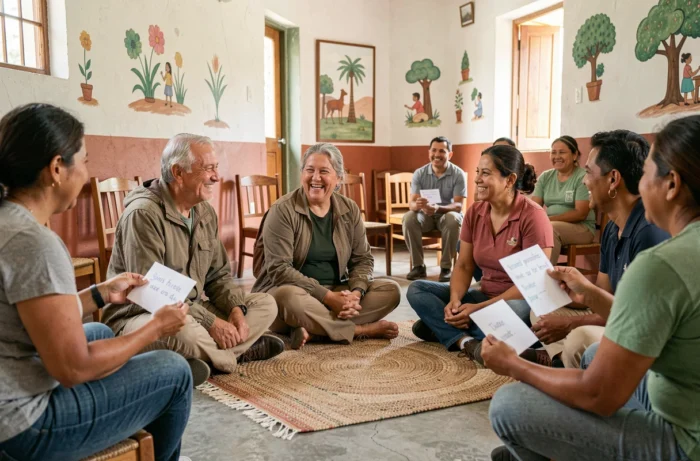
The most documented benefit for the solidarity traveler lies in the nature of the experience lived. Sharing the daily life of a family, participating in an agricultural or artisanal activity, discovering a territory through the eyes of those who live there: these moments produce a type of learning that conventional tourism does not offer.
Three concrete dimensions of the solidarity experience
- Real linguistic and cultural immersion, far from standardized circuits where contact with the population remains superficial
- Understanding the development challenges of a territory, observed from the inside and not through a documentary
- The feeling of reciprocity: the traveler receives as much as they give, which permanently alters their perception of travel
Stays take place in small groups, rarely more than ten people. This format reduces the impact on the host environment and fosters quality exchanges with the locals.
Choosing a reliable solidarity trip: verification criteria
With the tightening of European regulations, the question of the reliability of operators becomes central. Not all travel operators claiming to be “solidarity” operate according to the same standards.
The first criterion to check is financial transparency. A reliable operator publishes the breakdown of the price of the stay: the portion allocated to the community, the portion intended for local providers, and the portion retained by the agency. If this information is not accessible, caution is advised.
The second criterion concerns local anchoring. Partnerships must be built over time, with identified contacts on-site. An improvised solidarity trip, without a pre-existing link to the host community, offers no guarantee of real redistribution.
The third criterion focuses on the size of groups and the duration of stays. A two-day solidarity stay in a village, with thirty simultaneous visitors, is more akin to curiosity tourism than to a solidarity approach.
The European regulation coming into effect in 2026 will compel operators to prove their commitments. Until then, it is up to travelers to ask the right questions before booking, relying on criteria of financial transparency and territorial anchoring.