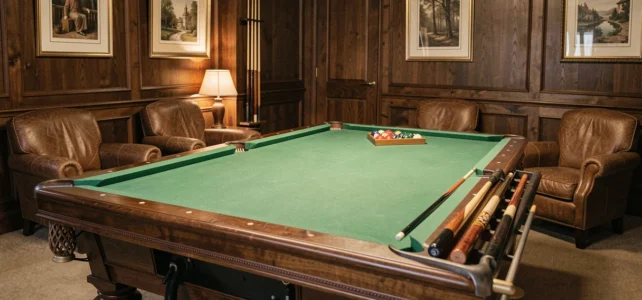
On a a carom billiard, a ball that deviates by a few millimeters after a rebound can turn a point won into a failure. This extreme sensitivity to playing conditions explains why heating the table remains a technical subject in its own right, far beyond mere comfort. The heated billiard modifies the behavior of the cloth, the reaction of the cushions, and the trajectory of the balls in a measurable way.
Hygrometric stability of the table: the true role of heating
Most discussions about heated billiards focus on rolling speed. The warm cloth would be “more rolling.” This is true, but it’s only part of the mechanism.
Heating first acts as a humidity regulator. The slate and cloth absorb ambient moisture. In a room where humidity varies (number of players, ventilation, season), the cloth changes behavior from hour to hour. The fabric swells slightly, the fibers straighten, and the ball encounters more resistance.
By keeping the surface a few degrees above ambient temperature, the heating system creates a localized dry zone. Moisture no longer stagnates in the cloth. The result is not just a fast billiard; it is a billiard whose behavior remains consistent throughout an entire gaming session or even an entire competition.
Clubs that have explored the benefits of a heated billiard often find that consistency takes precedence over raw speed. A stable cloth allows players to repeat their technical gestures with confidence.
Heating wire, plate, or film: compared heating techniques
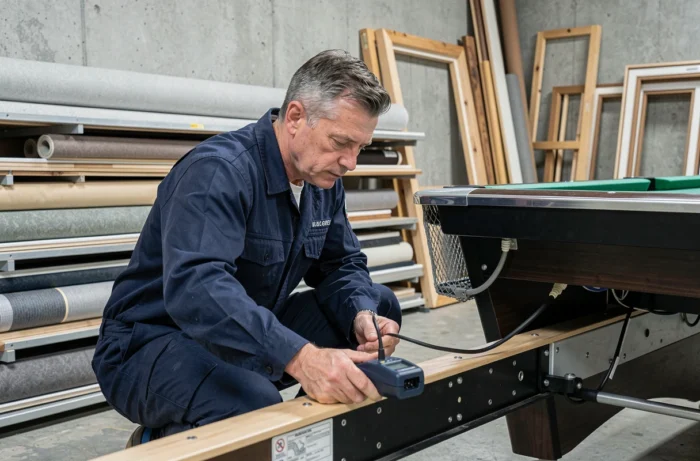
Have you ever looked under a club billiard? The heating device varies greatly from one installation to another, and the technical choice directly influences the thermal uniformity of the table.
Traditional resistive wire
This is the most common system in French clubs. A heating wire is laid out under the slate, above an insulating layer. The principle is simple and inexpensive, but it has a major flaw: the heat distribution depends on the layout of the wire. If the wire is laid in a loose coil, some areas of the table receive more heat than others.
The insulation also plays a critical role. Older installations used fiberglass that degrades over time, reducing the system’s efficiency and creating thermal losses downward.
Heating plates and films
More recent solutions use flexible heating films or conductive plates covering the entire surface under the slate. The main advantage is uniform thermal diffusion across the entire table. No hot spots, no cold areas.
The installation cost is higher, but the electrical consumption can be lower due to better efficiency. The film heats evenly at low power, while the resistive wire must reach higher temperatures to compensate for its dead zones.
- Resistive wire: inexpensive, easy to replace, but uneven thermal distribution if the layout is approximate.
- Flexible heating film: uniform coverage of the table, reduced consumption, more technical installation.
- Rigid conductive plate: maximum uniformity, high durability, but requires complete disassembly for installation.
Removal of Article 1.1.07: what this changes for clubs
The French Billiard Federation has removed Article 1.1.07 from the Sports Code, which required a playing surface temperature between 25 and 30 °C. Heating the surface is therefore no longer regulated for official competitions.
This decision is part of a context of energy sobriety. As billiard players interviewed by the Federation pointed out, clubs that pay for their electricity had already reduced their consumption, notably through insulating covers that can lower the bill by about 30%.
The removal of the obligation does not mean that heating is unnecessary. It opens the door to a more flexible approach: heating to a lower temperature, heating only during games, or investing in modern cloths whose behavior depends less on heat.

Modern cloths and reduced heating
Some manufacturers offer cloths designed to provide fast rolling without heating. The Royal Pro, for example, is cited by billiard players as an alternative that allows stopping heating without degrading game quality. The choice of cloth then becomes an inseparable parameter of the heating question.
Reducing consumption without sacrificing game quality
Must one necessarily choose between performance and savings? Not necessarily. Several levers allow limiting electrical consumption while maintaining stable playing conditions.
- Install an insulating cover on the billiard when it is not in use: this maintains the accumulated heat and reduces the heating time needed before a game.
- Program the heating with a thermostat set a few degrees above the room temperature, rather than aiming systematically for 30 °C.
- Monitor the humidity of the room with a hygrometer: a stable humidity level makes heating less necessary.
- Prioritize a quality cloth suited to the thermal conditions of the room.
The temperature of the room itself, the condition of the cushions, the wear of the cloth, and the number of people present all influence the behavior of the billiard. Heating the table is just one parameter among others, but it is the one on which a club can act most directly and quickly.
A well-maintained billiard, in a room with controlled temperature and humidity, offers reliable playing conditions, whether the table is heated to full power or maintained a few degrees above ambient. The goal remains the consistency of conditions, not the heat itself.