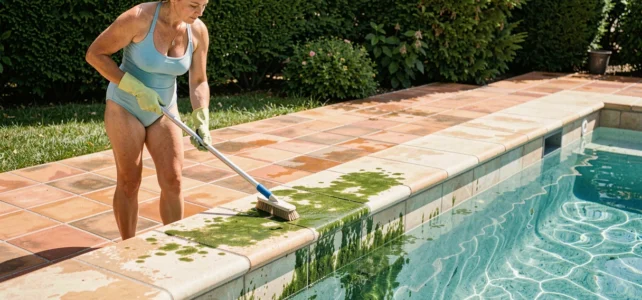
The water in your saltwater pool is turning green despite the electrolyzer running every day. This scenario affects many owners, including those who regularly monitor their pool. The problem rarely stems from a single cause: it is often a chain of small imbalances that allows algae to thrive. Understanding these mechanisms enables quick action and helps avoid repeated shock treatments.
Low Salinity Electrolyzer and Underproduction of Chlorine
Have you noticed that your electrolyzer is operating with less salt than before? Recent models operate around 2 g/L, which is half of what previous generations required, which was 4 to 5 g/L. This evolution reduces corrosiveness and simplifies maintenance, but it makes chlorine production more fragile.
In practical terms, a slight adjustment discrepancy is enough to cause free chlorine levels to drop. Short filtration times, a scaled cell, or an uncorrected temperature rise create a window where algae can develop in just a few hours. With a low salinity device, the margin for error is slim.
To compensate, you need to adjust the filtration duration to the water temperature. Above 28 °C, filtration should run continuously or nearly so. This is also the time to visually check the cell: a white limescale deposit on the plates reduces chlorine production without triggering any alerts on certain models. A comprehensive guide for fighting green algae in saltwater pools details the adjustments to make according to the season.
Phosphates and Copper in a Saltwater Pool: Two Overlooked Factors
Classic articles on green water discuss pH, chlorine, and filtration. They often overlook two parameters that play a direct role in algae proliferation: phosphates and copper ions.
How Phosphates Nourish Algae
Phosphates are natural nutrients for algae. They enter the pool through tap water, garden maintenance products, sunscreens, and even rain. High phosphate levels allow algae to proliferate even with a correct chlorine level.
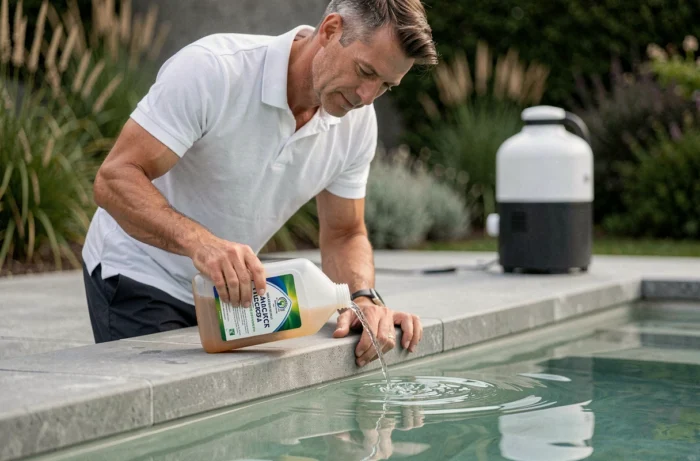
The trap is that standard test strips do not measure phosphates. A specific test kit or laboratory analysis is required. If your algae return despite normal chlorine and pH levels, this is the first avenue to explore. Sequestering products exist to lower phosphate levels, but they must be used before shock treatment, not after.
Green Deposits Related to Copper
Another common confusion: a green deposit on the walls is not always caused by algae. Copper ions from heat exchangers or plumbing produce similar green stains. Pools equipped with a heat pump are particularly affected, as the copper exchanger can release ions when the pH drops too low.
An anti-algae treatment applied to a copper deposit will not resolve anything. A dissolved copper test can clarify the situation. If copper is the culprit, correction involves adjusting the pH (between 7.2 and 7.4 for a saltwater pool) and using a metal sequestering product.
Recovery Protocol When the Water is Already Green
When algae are established, the order of actions is as important as the products used. Here is the sequence that yields results without wasting product.
- Manually brush the walls, bottom, and tile joints before any chemical treatment. Algae form a biofilm that protects the chlorine cells. Without brushing, the shock loses much of its effectiveness.
- Clean the filter (backwash for a sand filter, rinse for a cartridge) and check the electrolyzer cell. A clogged filter recirculates algae spores into the pool.
- Adjust the pH between 7.0 and 7.4 before adding any treatment product. A pH above 7.6 significantly reduces chlorine effectiveness.
- Perform a shock treatment suitable for salt (preferably calcium hypochlorite, as it does not add stabilizer). Let the filtration run continuously until the water becomes clear.
- Add an anti-algae treatment as a maintenance dose once the water is clear, not during the shock phase. The anti-algae prevents recolonization; it does not kill already present algae.
Preventive Maintenance: What Prevents Recurrence in Saltwater Pools
Recovering green water takes time and consumes products. Prevention is cheaper and mainly requires consistency.
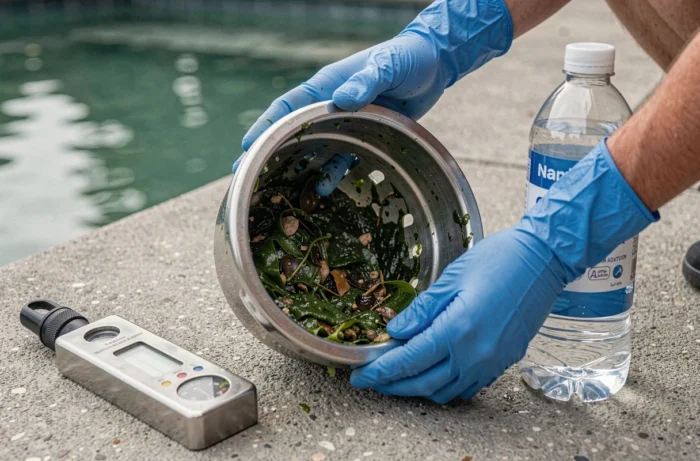
Test free chlorine and pH twice a week during the warm season. Test strips are sufficient for regular monitoring, but a drop test or electronic test is more reliable for free chlorine. The electrolyzer sometimes shows normal production while the actual chlorine in the pool is insufficient.
The electrolyzer cell should be inspected monthly in summer. Soaking in an appropriate acidic solution (diluted white vinegar or specific product) removes limescale without damaging the plates. A clean cell produces up to twice as much chlorine as a scaled cell.
Also, remember to check the salt level at least once a month. Evaporation and fresh water additions gradually dilute the concentration. A level that is too low reduces chlorine production without triggering an alarm on all electrolyzer models.
The last point concerns stabilization. In a saltwater pool, the stabilizer (cyanuric acid) accumulates over the seasons as it does not degrade. Beyond a certain threshold, it blocks the action of free chlorine. The only solution to lower an excessively high stabilizer level is to partially drain the pool. Renewing one-third of the water volume at the beginning of the season limits this phenomenon.